编号:CDUT-2024-39
标题:The Permian Chert Event in South China: New geochemical constraints and global implications
入藏号:WOS:001124242300001
中国科学院文献情报中心期刊分区:地球科学1区TOP(2023)
本校作者:张柏林;穆兰;黄虎; 郎咸国
来源出版物:EARTH-SCIENCE REVIEWS 卷: 244 文献号: 104513
出版年:2023
第一地址: 成都理工大学
关键词: Late Paleozoic;Silica source;Chert;Upwelling;South China
代表图:
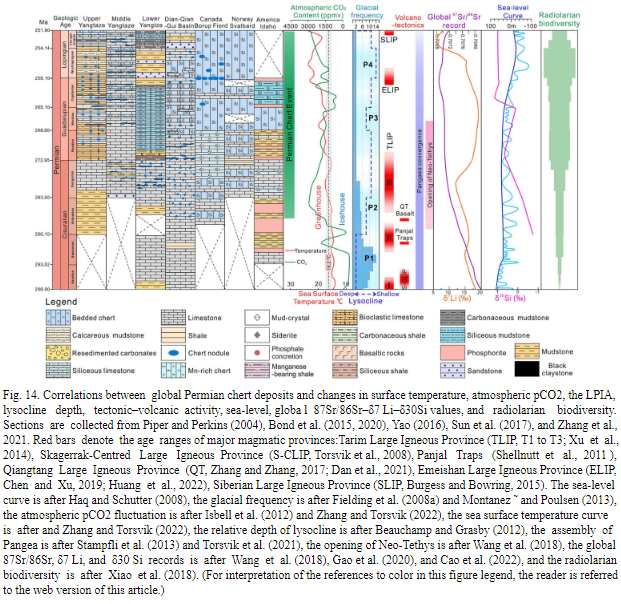
摘要:The Permian Chert Event (PCE) was an unusual global chert accumulation that reflects tectonic–climatic–environmental changes during the late Paleozoic. South China was located near the equator in the easternPaleo-Tethys Ocean at this time, and this region developed massive chert deposits during the Permian as part ofthe PCE. However, it is unclear whether upwelling-driven biological processes or tectonically related hydrothermal activity was the dominant origin for these cherts. To address this, we conducted a petrological andgeochemical investigation of the chert deposits in the Lower Yangtze region, South China, and compared ourresults with those for cherts from other regions of South China. Our results show that dissolved silica derivedfrom terrestrial input or silica-rich seawater was the dominant source of silica in the Permian cherts, whichlocally mixed with hydrothermal or volcanic silica sources. The strong positive correlation between biogenicsilica and upwelling intensity, combined with the abundant siliceous organisms in the cherts, further indicatesthat upwelling-driven biological processes controlled the formation of the Permian cherts in South China. ThePCE in South China began in the early Kungurian and peaked in the Guadalupian, which is slightly different fromthe timing in northwestern Pangea at higher latitudes. However, the PCE ended in all regions at the end of theLopingian. The beginning of the PCE coincided with the waning of the Late Paleozoic Ice Age, which was causedby coeval tectonic and volcanic activity. With increased silicate chemical weathering during the interglacialperiod, vigorous upwelling driven by globally enhanced thermohaline circulation transported nutrients anddissolved silica to the surface ocean. This promoted the flourishing of siliceous organisms and the globaldevelopment of biogenic chert. Coupled oceanic circulation and continental weathering, combined with thegradual lysocline shoaling, had a significant role in the expansion of the PCE. The cessation of chert depositionmay have been related to the end-Permian severe environmental crisis and mass extinction
文章链接地址:https://www.sciencedirect.com/science/article/pii/S0012825223002027?via%3Dihub





 校内登录
校内登录