编号:
CDUT-2024-27
标题:Microplastics spatiotemporal distribution and plastic-degrading bacteria identification in the sanitary and non-sanitary municipal solid waste landfills
入藏号:WOS:000821324600003
中国科学院文献情报中心期刊分区:环境科学与生态学1区TOP(2022)
本校作者:李娜英;韩智勇*;郭南飞;周志强;刘莹
* Corresponding author
来源出版物:JOURNAL OF HAZARDOUS MATERIALS 卷: 438 文献号: 129452
出版年:2022
第一地址:成都理工大学
关键词:Microplastics;Plastic-degrading microorganisms;Spatiotemporal distribution;Degradation mechanism;Municipal solid waste landfill
代表图:
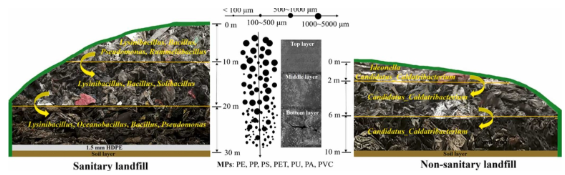
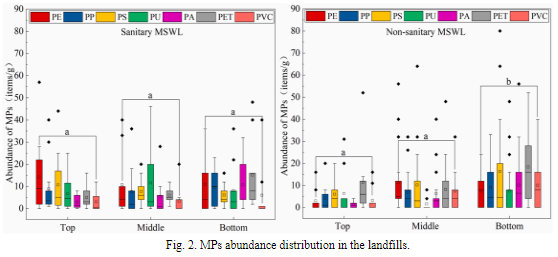
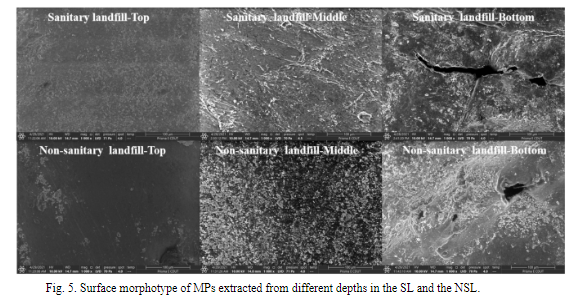
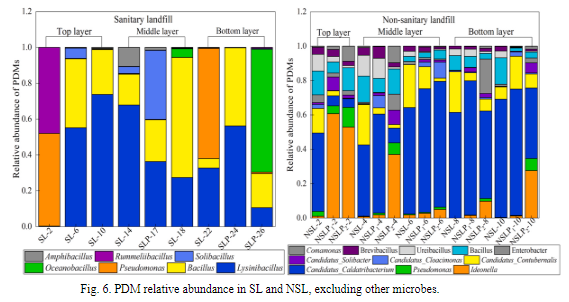
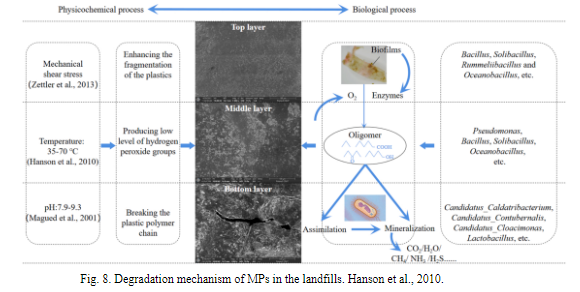
摘要:The municipal solid waste landfill (MSWL) is an important source of microplastics (MPs) and a huge bioreactor for plastic-degrading microorganisms (PDM). However, the spatiotemporal distribution and degradation mechanisms of MPs in MSWLs are unclear. Therefore, they were studied using the samples drilled in a sanitary landfill (SL) and an non-sanitary landfill (NSL). The results showed that there were a lot of polyethylene (PE), polypropylene (PP), polystyrene (PS), polyurethane (PU), Polyamide (PA), Polyethylene terephthalate (PET) and Polyvinyl chloride (PVC) in the landfill, and their abundance ranged from 0 to 80 items/g. The MPs surface gradually faded, became rough and even yielded cracks and holes with the landfill depth and age increase. The tiny-size MPs (< 100 mu m) were the most abundant and their amount significantly increased from 28.14% to 49.13% in SL and from 24.54% to 59.51% in NSL, respectively, while large-size MPs were significantly reduced from the top to the bottom. Lysinibacillus (0.21%-67.87%) and Bacillus (0.10%-67.00%) were the dominate PDMs in SL and Candidatus_Caldatribacterium (5.06%-73.48%) was the dominate in NSL. The PE degradation was closely related to Candidatus_Cloacimonas (r = 0.688*) and Candidatus_Caldatribacterium (r = 0.680*); PS and
文章链接地址: https://linkinghub.elsevier.com/retrieve/pii/S0304389422012456





 校内登录
校内登录