编号:CDUT-2024-2
标题:Spatio-temporal patterns and drivers of carbon-water coupling in frozen soil zones across the gradients of freezing over the Qinghai-Tibet Plateau
入藏号:WOS:001011754400001
中国科学院文献情报中心期刊分区:地球科学1区/TOP (2023)
本校作者:王翔,陈果*,曹龙熹
来源出版物: JOURNAL OF HYDROLOGY 卷: 621 文献号: 129674
出版年:2023
第一地址:成都理工大学
关键词:Introduction;Materials and methods;Results;Discussion;Conclusions
代表图:
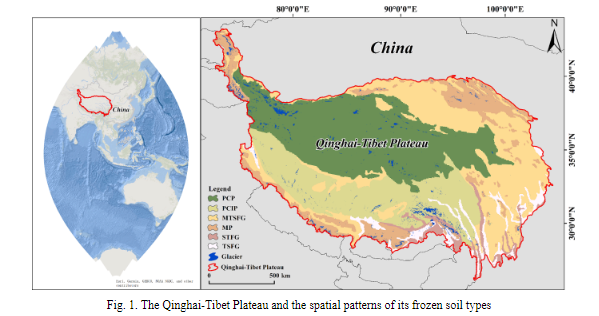
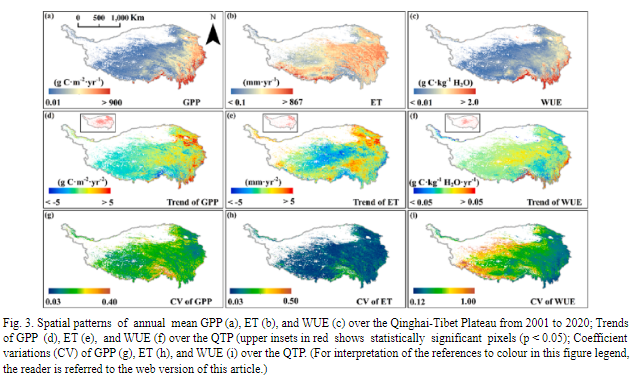
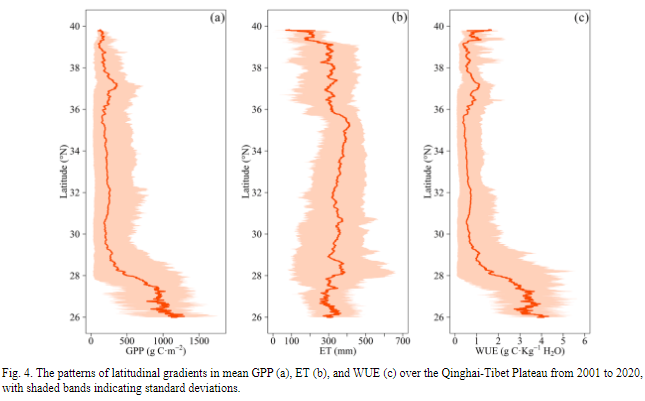
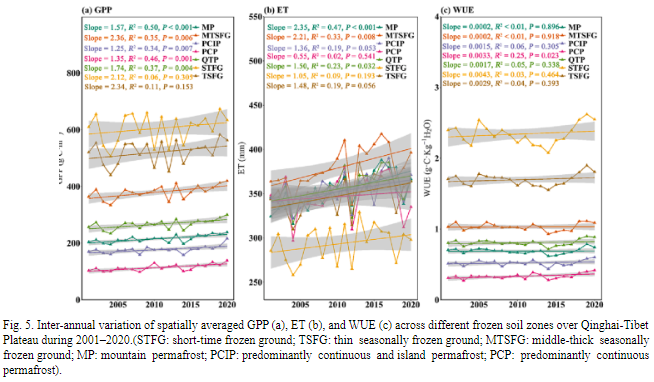
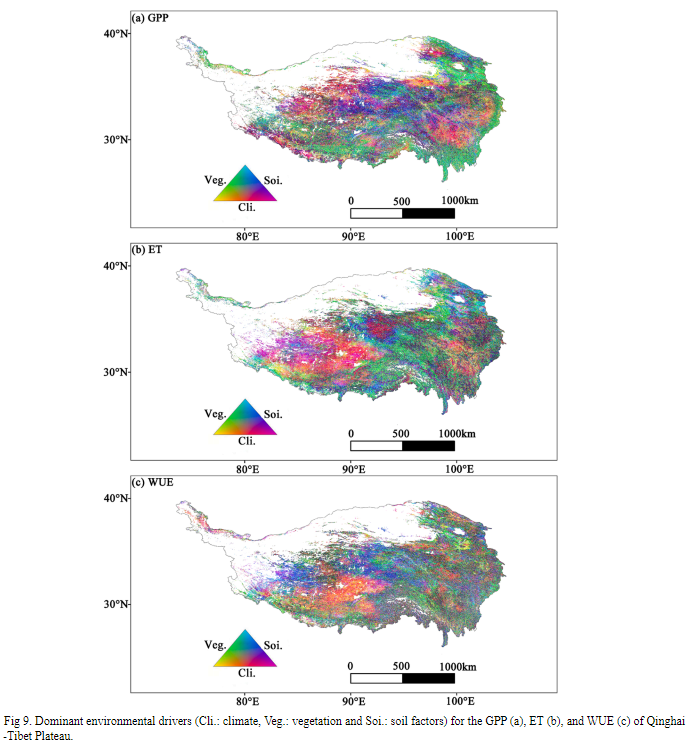
摘要:The carbon and water cycle patterns of frozen soil ecosystems in regions, such as the Qinghai-Tibet Plateau (QTP), which have fragile and sensitive ecologies, are possibly affected by climate change. However, these patterns along the gradients of varying degrees of freezing remain poorly understood. In this study, we examine the spatio-temporal patterns of water use efficiency (WUE), gross primary productivity (GPP), and evapotrans-piration (ET) in six frozen soil zones of the Qinghai-Tibet Plateau (QTP) with varying degrees of frozen soil. The analysis is based on the frozen soil classification criteria and remote sensing data from 2001 to 2020. The in-fluences of six climatic, nine edaphic, and two botanic parameters on these patterns is also investigated. The results indicate that 48.05%, 24.07%, and 20% of the regions in QTP exhibit significantly upward trends of GPP, ET, and WUE, respectively. The highest increase trends were observed in GPP in the middle-thick seasonally frozen ground zone (2.36 g C m 2 yr 1), ET in the mountain permafrost zone (2.35 mm yr 1), and WUE in the predominantly continuous permafrost zone (0.003 g C kg 1 H2O yr 1). Meanwhile, GPP and WUE decrease progressively with the increase of freezing degrees, from the short-time frozen ground zone (GPP: 604.99 & PLUSMN; 51.99 g C m 2; WUE: 2.34 & PLUSMN; 0.15 g C kg 1 H2O) to the predominantly continuous permafrost zone (GPP: 114.07 & PLUSMN; 11.77 g C m 2; WUE: 0.33 & PLUSMN; 0.04 g C kg 1 H2O), while ET does not show significant differences across the three permafrost zones. The enhanced vegetation index is the primary factor affecting GPP and WUE in most frozen soil zones, whereas climate variables mainly impact ET. Our findings emphasize the importance of considering the effects of different freezing degrees of frozen soil when analyzing the response of the carbon and water cycles in the QTP in the context of climate change.
文章链接地址: https://www.sciencedirect.com/science/article/pii/S0022169423006169?via%3Dihub





 校内登录
校内登录