编号:CDUT-2023-67
标题:Early Jurassic long-term oceanic sulfur-cycle perturbations in the Tibetan Himalaya
入藏号:WOS:000784334800003
中国科学院文献情报中心期刊分区:地球科学1区TOP(2022)
本校作者:韩中
来源出版物:EARTH AND PLANETARY SCIENCE LETTERS 卷: 578 文献号: 117261
出版年:2022
第一地址:成都理工大学
关键词:sulfur-isotope perturbations; seawater sulfate concentrations; Early Jurassic; carbonate platform; Tibetan Himalaya ;southern hemisphere
代表图:
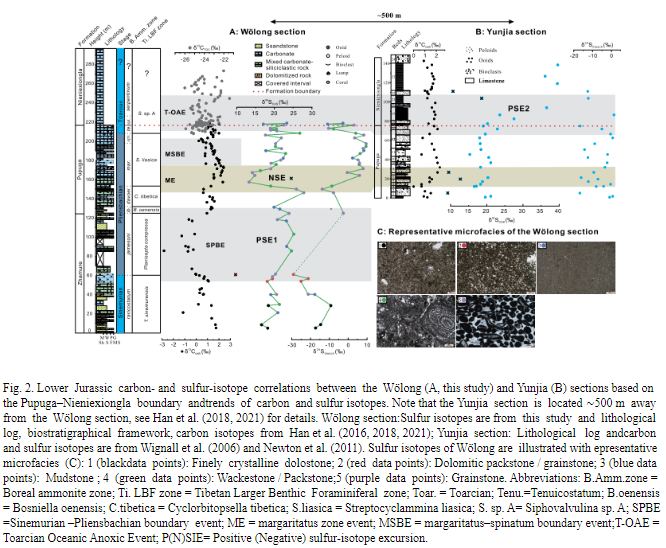
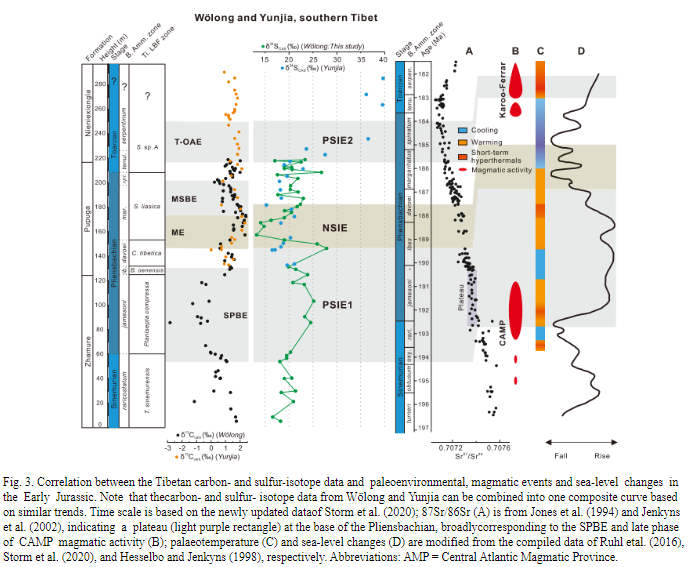
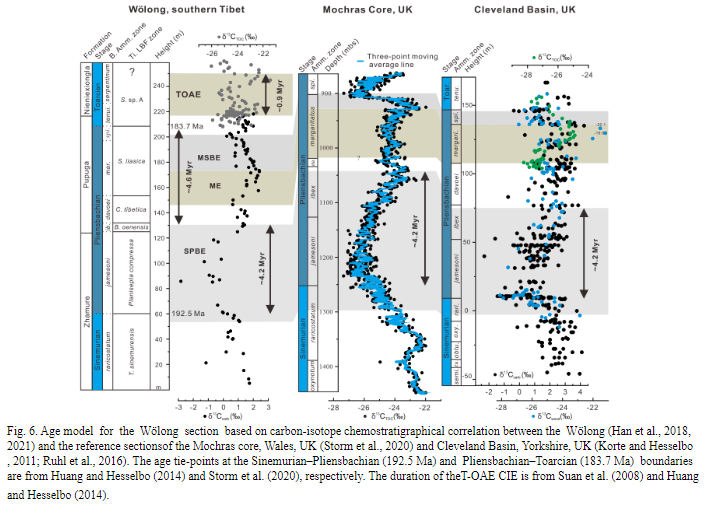
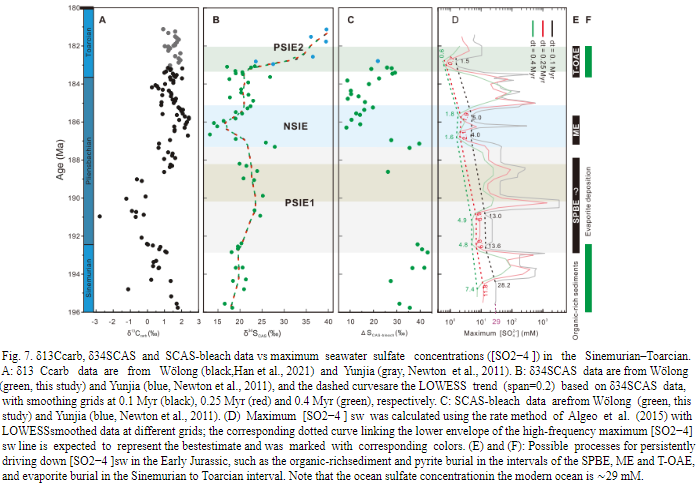
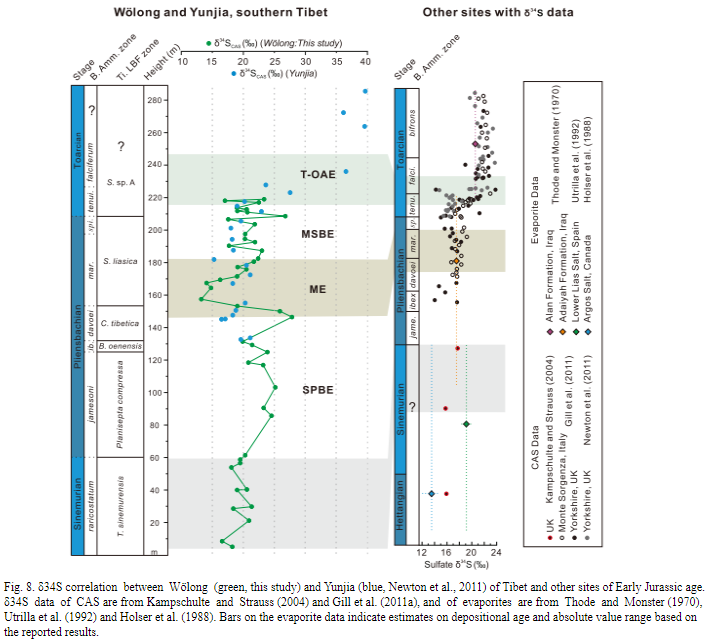
摘要:The Early Jurassic is an important interval characterized by several global carbon-isotope (C) perturbations. Although the C records are becoming better documented during this time interval, we have a relatively poor understanding of the associated long-term environmental and climatic changes. In order to decipher these events, we here present new stable sulfur-isotope data of carbonate-associated sulfate (SCAS) for the Sinemurian–Pliensbachian interval from the Wölong section in the Tibetan Himalaya that was located palaeogeographically in the southern hemisphere. An overall positive shift in SCAS coincides with the negative C excursion around the Sinemurian–Pliensbachian boundary, suggesting an increased 34S-depleted pyrite burial rate. The ensuing overarching negative SCAS shift coincides with the upper Pliensbachian positive C excursion. The initial falling limb of the SCAS shift suggests a transient S-depleted sulfate input, but this trend was soon reversed to become positive, likely caused by a persistently enhanced 32S-rich pyrite burial flux in the latest Pliensbachian.Modeling results show that maximum oceanic sulfate concentration likely decreased during the Sinemurian–Toarcian interval, probably due to large-scale evaporite deposition in the western Tethys and proto-Atlantic and enhanced pyrite burial in a number of marine settings. The concentration of seawater sulfate could have been high enough to maintain a homogeneous sulfur-isotope ocean in the late Sinemurian, but its persistent decrease may have initiated a spatially heterogeneous ocean after the Pliensbachian: an oceanic geochemical state that was amplified during the Toarcian Oceanic Anoxic Event.
文章链接地址: https://www.sciencedirect.com/science/article/pii/S0012821X21005173?via%3Dihub





 校内登录
校内登录