编号:
CDUT-2023-45
标题:Prospects for Eocene potash deposition in the East Tethyan domain: New evidence from fluid inclusions and chlorine isotope of halite crystals in the Kuqa Basin, NW China
入藏号:WOS:000927029500001
中国科学院文献情报中心期刊分区:地球科学2区(2022)
本校作者:于会冬,邹灏*,伍江涵,陈海锋,黄长成,朱贺
来源出版物:Ore Geology Reviews 卷: 154 文献号: 105313
出版年:2023
第一地址:成都理工大学
关键词:特提斯海,库车盆地,流体包裹体,氯同位素,钾盐沉积前景
代表图:
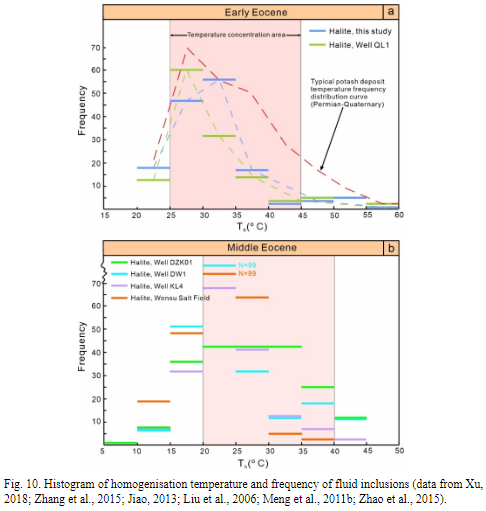
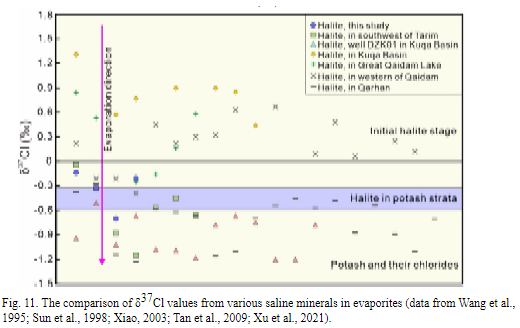
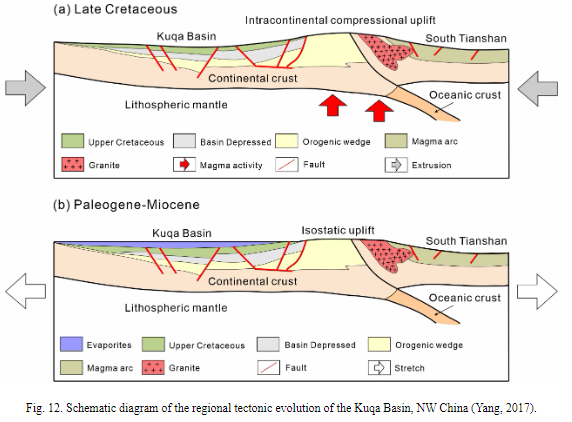
摘要:The level of the Tethys Sea increased several times during the deposition of Mesozoic to Cenozoic sediments in the Kuqa Basin in the Tarim Block. The basin contains Paleogene to Neogene units containing evaporite-rich layers, which are favourable sources for economic concentration of potash (K-rich salt). However, the basin’s geology is poorly understood, lacking knowledge of the source of the brine, paleo-water temperatures, and the degree of evaporation. As a result, the exploration for potash mineralisation has been limited. This study documents the geochemistry, fluid inclusions, and Cl-isotope of Early Eocene halite crystals from the Kuqa Basin. The results show that the homogenisation temperatures of primary fluid inclusions in halite range between 20° and 57 ℃, which is close to the temperature range of the seawater in the Tethyan sea during the same period. The average value of ~ 32 ℃ is taken as the average temperature of the salt-forming brine in the Early Eocene. The homogenisation temperatures of the inclusions are generally high, with a maximum temperature of ~ 57 ℃, which is consistent with the global Paleocene–Eocene thermal maximum (PETM) climatic event, indicating that the salt-forming brine has experienced long-term and sustained high temperatures and short-term extremely high temperatures. This is consistent with the high temperatures recorded during the deposition of potash in other parts of the earth, such as ~ 59 ℃ for the Silurian Michigan Basin in the USA and ~ 58 ℃ for the Quaternary Lop Nur region in Mongolia. In addition, the Br content of the halite samples is between 58 and 125 ppm, and the Br × 103/Cl value is between 0.11 and 0.21, which is consistent with the evaporation curve of seawater, indicating that there is a marine environment favourable for potash deposition. The value of δ37Cl is between − 0.7 and − 0.14 ‰ showing that the salinity of the brine evolved to a higher concentration, especially during the later stage of potash deposition. This indicates that the potential for the presence of potash deposits in the Early Eocene Kuqa Basin is high.
文章链接地址:https://doi.org/10.1016/j.oregeorev.2023.105313





 校内登录
校内登录