编号:CDUT-2023-5
标题:The link between Paleo-Tethys subduction and regional metallogeny in the SW Yangtze Block: New evidence from the Zubu carbonate-hosted F-Pb-Zn deposit
入藏号:WOS:000799947900001
中国科学院文献情报中心期刊分区: 地球科学2区(2022年升级版)
本校作者:邹灏、喻黎明、肖斌、胡成辉、黄长成、陈海锋
来源出版物: ORE GEOLOGY REVIEWS 卷: 144 文献号: 104809
出版年:2022
第一地址:成都理工大学
关键词:Lead-zinc mineralization belt;Yangtze Block;Zubu F-Pb-Zn deposit;Sm-Nd dating;H-O-Sr-Pb isotopes
代表图:
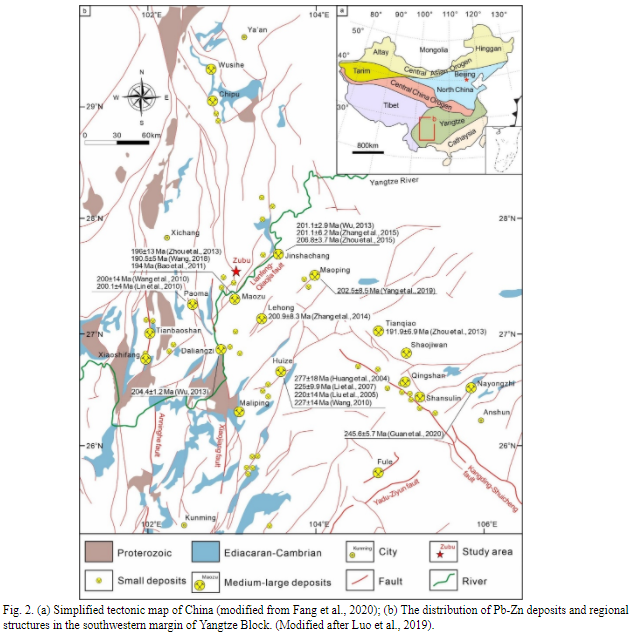
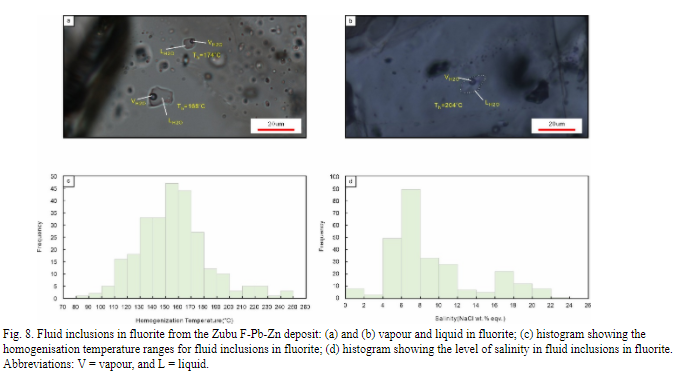
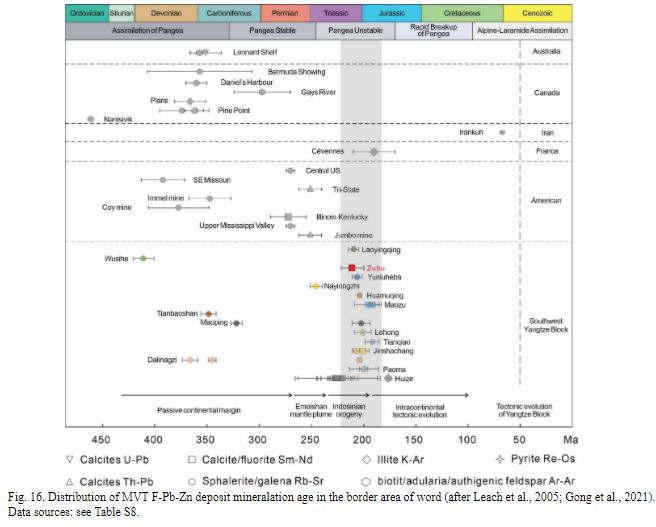
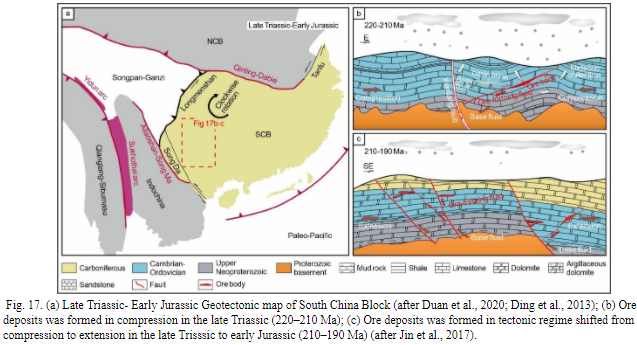
摘要:The lead–zinc mineralization belt along the southwestern margin of the Yangtze B lock is one of the important source for lead, zinc, germanium and silver in China. More than 50% of the deposits in the region occur in carbonate rocks ranging in age from late Ediacaran to early Cambrian. Here we investigate the large Zubu F-PbZn deposit located in the southwestern margin of the Yangtze Block. The ore bodies strike nearly NS in the dolomite fracture zone in the second member of the Cambrian Longwangmiao Formation and discontinuously extend for 0.7 km long. We present Sm-Nd isotopic data on the fluorite ore that yield an isochron age of 211 ± 11 Ma. Fluid inclusions in the fluorite show homogenization temperature between 88 and 247 ◦C with a peak at 130–180 ◦C, with salinity ranging between 0.18 and 22.23 wt% NaCl eqv. (average of 9.24 wt% NaCl eqv.), the ore-forming fluid has the characteristics of medium–low temperature and medium–low salinity. The rare earth element (REE) signature of fluorite display positive Eu anomaly and negligible negative to weak positive Ce anomaly. The δ18OV-SMOW values range from 0.6 − 4.7 ‰, δDV-SMOW values range from − 41.1–27.6 ‰, fluorite Sr isotopic values range from 0.710668 to 0.711585, and galena Pb isotope ratios with the value of 206Pb/204Pb = 18.551–18.564, 207Pb/204Pb = 15.676–15.693, 208Pb/204Pb = 38.869–38.809. The field, petrologic, geochemical and isotopic data from our study lead to the following salient findings. (1) The ore-forming fluid of the F-Pb-Zn deposit was derived from the mixture of metamorphic water flowing through the basement with basin hot brine and meteoric water. (2) The ore-forming material of the deposit comes from the basement and sedimentary strata. (3) In conjunction with the geochronological data of regional ore deposits, the large-scale mineralization is inferred to have formed during a transitional stage from compression to extension setting related to the Indosinian orogeny after the closure of the late Triassic-early Jurassic (220–190 Ma) Paleo-Tethys Ocean.
文章链接地址: https://doi.org/10.1016/j.oregeorev.2022.104809





 校内登录
校内登录