编号:CDUT-2022-13
标题:Soil microbes become a major pool of biological phosphorus during the early stage of soil development with little evidence of competition for phosphorus with plants
入藏号:WOS:000501246300002
中国科学院文献情报中心期刊分区:农林科学2区/TOP(2020)
本校作者:王吉鹏;李景吉
来源出版物: PLANT AND SOIL 卷: 446 期: 1-2 页: 259-274
出版年:2020
第一地址:成都理工大学
关键词:Soil microbial biomass;Phosphorus;cycling;Phosphomonoesterase;Primary succession;Hailuogou chronosequence
代表图:
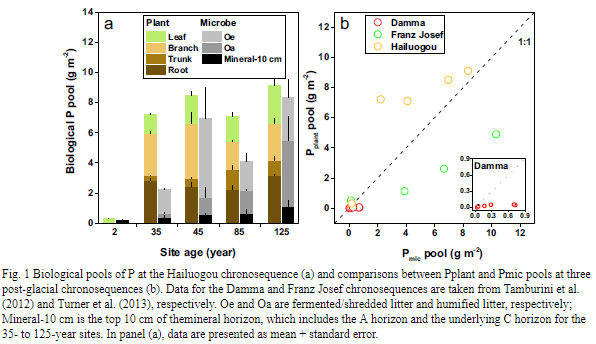
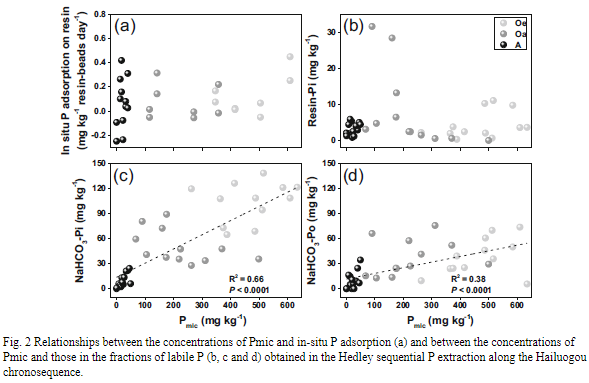
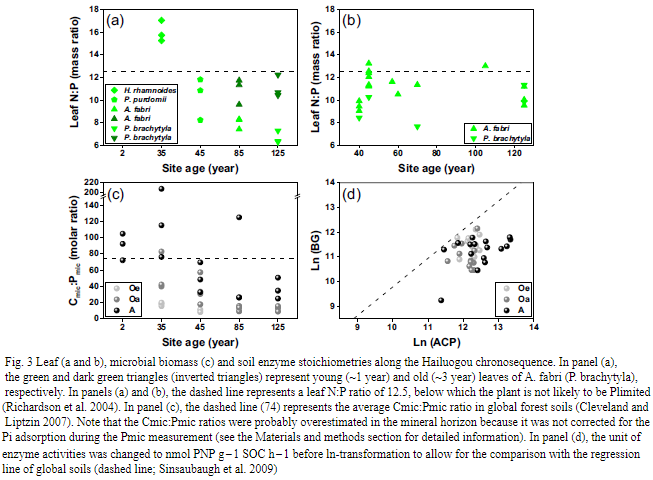
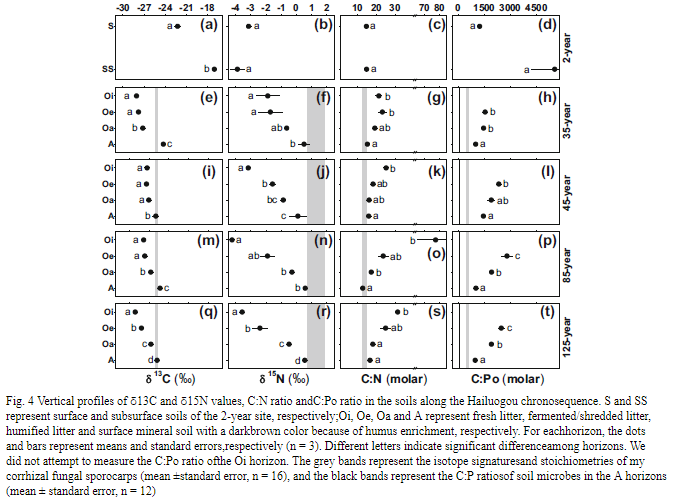
摘要:Aims We aimed to quantify the pool size of soil microbial biomass P (P-mic) during the early stage of soil development up to 125 years after glacial retreat in the Gongga Mountains, China and relate the pool size of P-mic to the plant P (P-plant) pools in the ecosystem. Methods We determined the pool sizes of P in soil microbes, plants and soils and the P fluxes with plant uptake and litterfall in successional ecosystems at five study sites along the 125-year Hailuogou glacial retreat chronosequence. Moreover, we estimated the flux of P cycled through microbial biomass (P-mic cycling) based on literature data. We also approached the likelihood of P competition between plants and soil microbes based on the P status of the plants, soils and soil microbes. Results The size of the P-mic pools (0.2-8.3 g m(-2)) in the organic layer and top 10 cm of the mineral soils was comparable to that of the P-plant pools (0.3-9.1 g m(-2)) at all study sites along the Hailuogou chronosequence. Based on the literature, the P-mic cycling at our study site (0.3-13.5 g m(-2) year(-1) if estimated based on temporal fluctuations of P-mic, 5.2-268 g m(-2) year(-1) if estimated based on the isotope dilution method) was at least one order of magnitude larger than the P-plant uptake (not detected-0.36 g m(-2) year(-1)) and the P-plant return by litterfall (not detected-0.16 g m(-2) year(-1)). Although P-mic became a major pool of biological P, we did not find indications of P competition between plants and soil microbes as indicated by the positive relationships between the concentrations of P-mic and plant-available P in soils and the P-rich status of plants and soil microbes. Conclusions Soil microbial biomass already becomes a major P pool in the early stage of soil development. Our estimations based on the literature suggest that P-mic cycling is probably the largest P flux in the studied up to 125-year ecosystems. Plants likely did not suffer P competition with microbes, in part due to the preferential decomposition of the P-rich compounds from dead microbial biomass which led to net P mineralization.
文章链接地址: https://link.springer.com/article/10.1007/s11104-019-04329-x





 校内登录
校内登录