编号:CDUT-2022-37
标题:Formation of Late Ordovician marine red beds: A case study of Sandbian deposits in the Tarim Basin, Northwest China
入藏号:WOS:000709727100002
中国科学院文献情报中心期刊分区:地球科学1区/TOP (2021年升级版)
本校作者:刘欣春;侯明才;常晓琳;王嵩;Ogg, James G.;罗宏谓;张虹瑞;穆财能;刘宇
来源出版物:GLOBAL AND PLANETARY CHANGE 卷:207 文献号:103669
出版年:2021
第一地址:成都理工大学
关键词:Late Ordovician;Marine red beds;Elemental geochemistry ;South Tianshan Ocean;Paleomarine redox environment;Diffuse reflection spectroscopy
代表图:
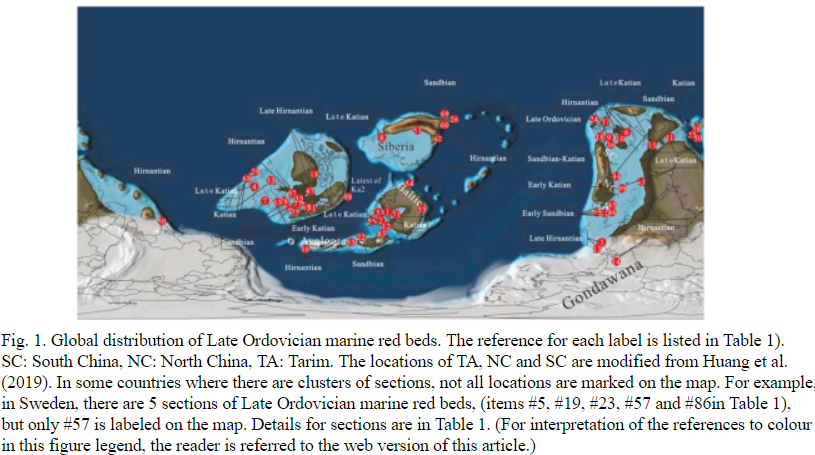
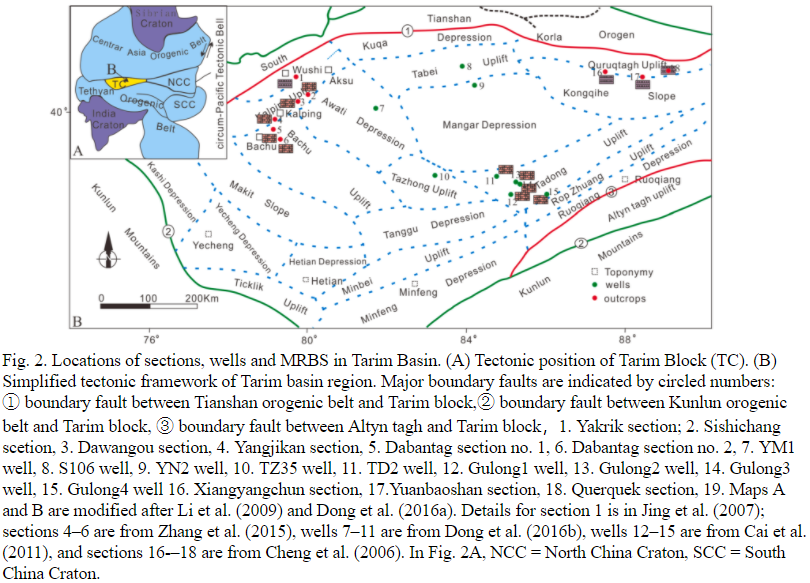
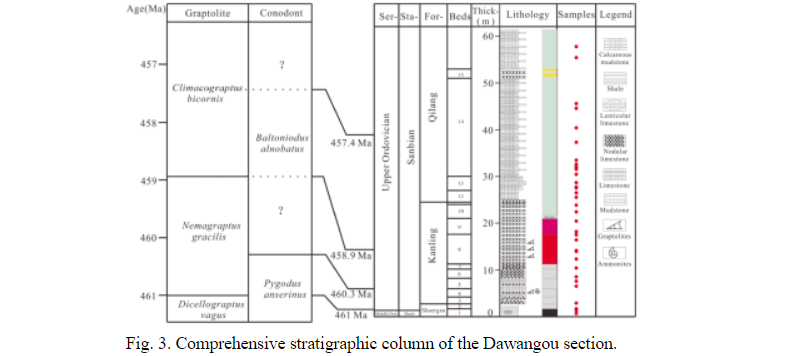
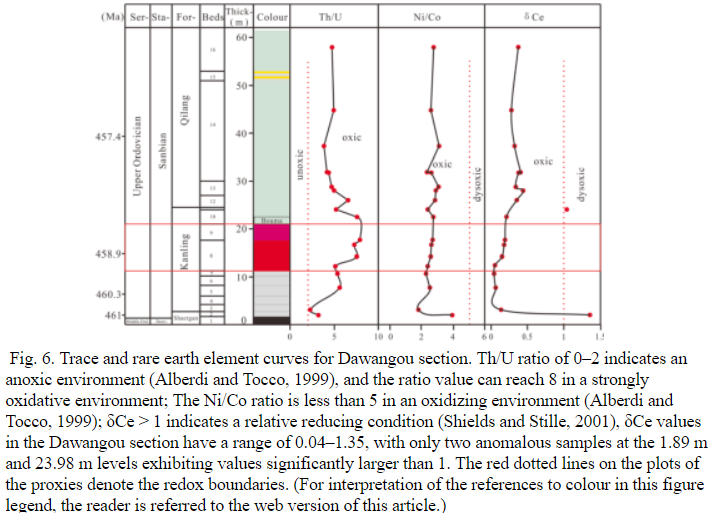
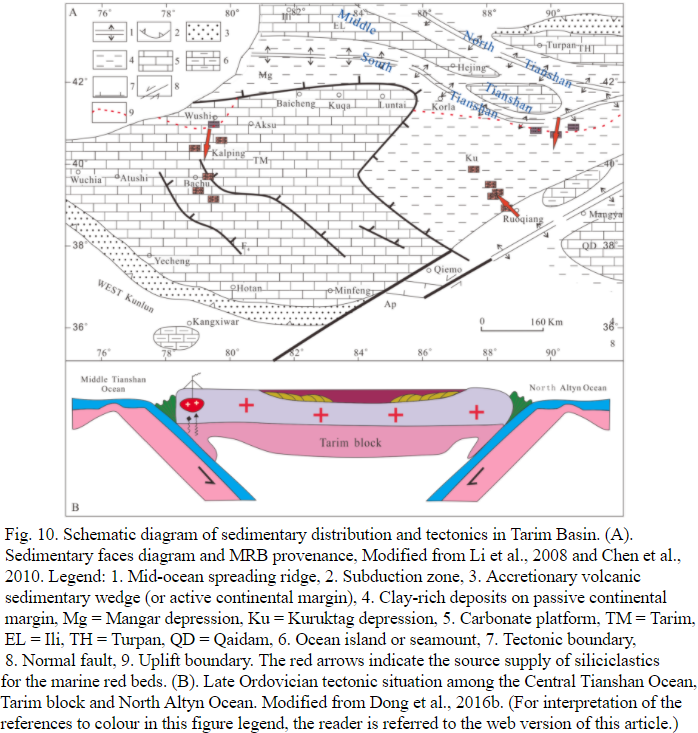
摘要:The late Ordovician was an important transition interval between the mid-Ordovician biological radiation and end-Ordovician extinction. Marine red beds (MRB) of Late Ordovician are distributed worldwide, including in the Americas, South Africa, England, and China. Among them, the conditions that contributed to the widespread Katian MRB was a combination of terrigenous input, cool-water settings, sediment oxidation, volcanic material input, and seasonal aridity. In contrast, Hirnantian MRB have a more limited distribution, and their occurrence might be related to regional tectonic settings and icehouse conditions. Sandbian MRB are distributed worldwide, but are relatively poorly studied. Even though Sandbian MRB are very similar in some characteristics to the Katian MRB, we don’t know which factors were important to their formation and how these were related to marine environmental change and tectonic evolution. The Dawangou section near Kalping in the Tarim Basin of northwest China is an important global reference section for the auxiliary GSSP of the Middle–Late Ordovician boundary and for Sandbian through early Katian biostratigraphy and chronostratigraphy. Diffuse reflection spectroscopy, major and trace element analysis, rare earth element analysis, and sedimentology were employed to study the interval of Sandbian MRB in the Kanling Formation (within the N. gracilis graptolite zone) relative to underlying and overlying deposits. The red-colored strata have elevated total Fe and hematite contents, whereas the grey and grey-green samples have much a lower total Fe and a significant lack of hematite and goethite. The total Fe content for strata within the Sandbian MRB varies with the clay content. The Al–Fe correlation within the Sandbian MRB is 0.9, whereas it is 0.6 for the non-red sediments. The Th/U ratio is much higher in the redcolored beds (averaging 7.0) relative to the underlying and overlying sediments (averaging 4.4). However, a redox proxy of Ni/Co ratios does not exhibit a significant difference between the underlying and overlying sediments (averages of 2.6 and 2.8) and the reddish Sandbian MRB interval (average of 2.6). The results indicated that the Sandbian marine red beds of the Tarim were formed during conditions of marine oxygenation that helped form and preserve the iron oxide. However, the regional distribution and aspects of the sediment geochemistry imply that another essential process for the formation of these Sandbian MRB was the influx of terrestrial iron-rich sediments from the exposed uplifts into the mixed shelf regions; and that this influx was partly governed by the regional patterns of southward subduction of the South Tianshan ocean and of northward subduction of the Altyn to the margins of the Tarim block.
文章链接地址:https://www.sciencedirect.com/science/article/pii/S092181812100254X?via%3Dihub





 校内登录
校内登录