编号:CDUT-2022-35
标题:Uranium enrichment in the Lala Cu-Fe deposit, Kangdian region, China: A new case of uranium mineralization associated with an IOCG system
入藏号:WOS:000596077000001
中国科学院文献情报中心期刊分区:地球科学2区/TOP(2020年升级版)
本校作者:宋昊;张成江;徐争启
来源出版物:ORE GEOLOGY REVIEWS 卷: 121 文献号: 103463
出版年:2020
第一地址:成都理工大学
关键词: Uranium mineralization;IOCG deposit;Lala deposit;EPMA;Southwest China
代表图:
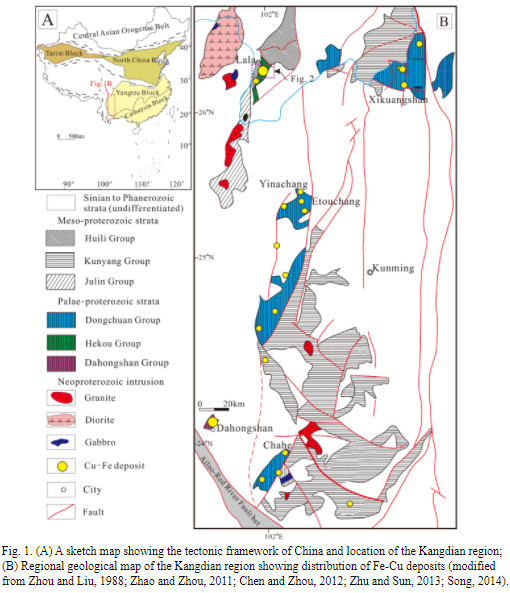
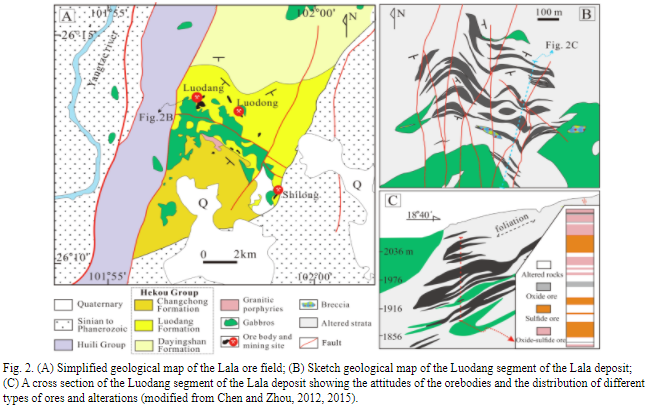
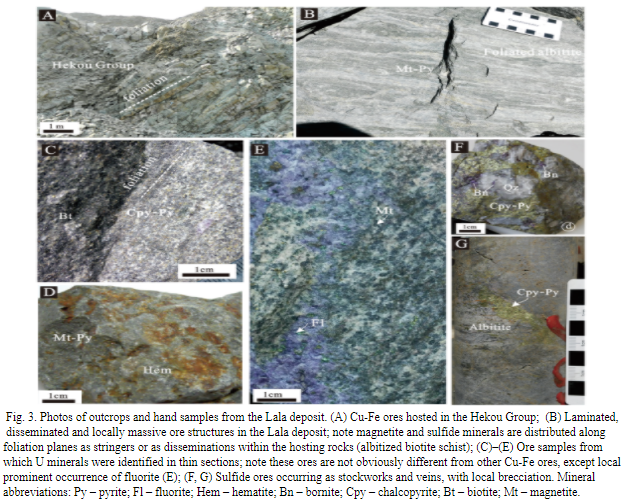
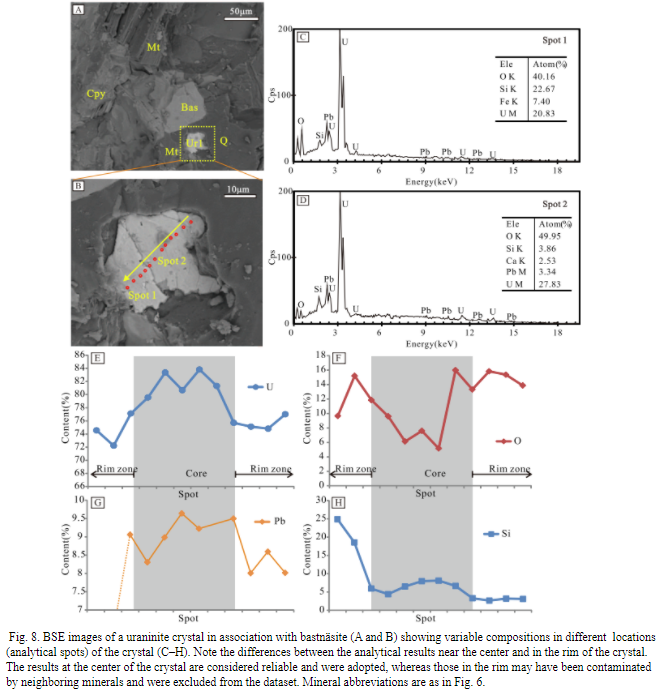
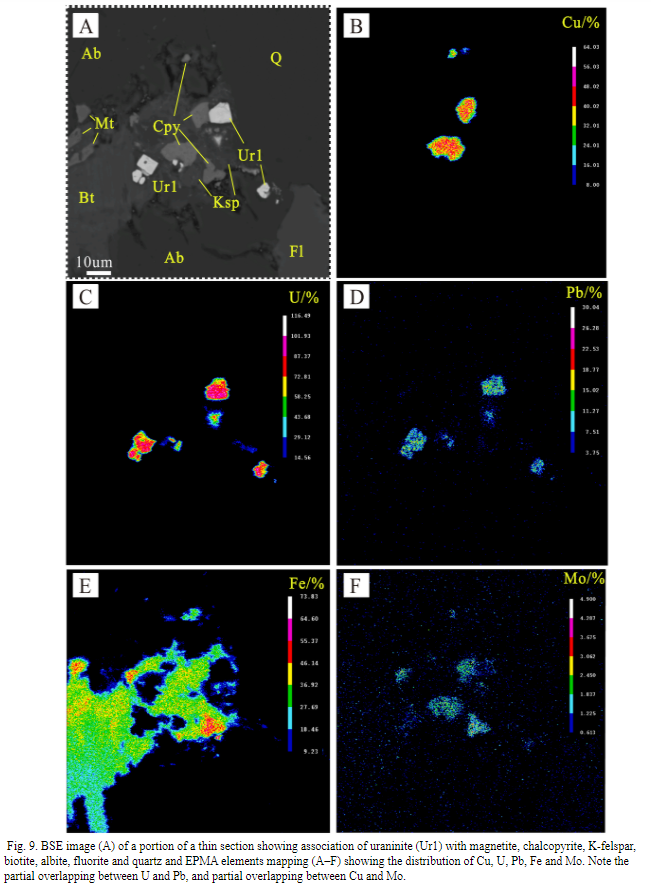
摘要:Elevated uranium concentrations have been reported in many IOCG deposits, but detailed information about the occurrences of uranium minerals and their relationships with other minerals remains scarce, which hinders understanding of the mineralization mechanisms and the nature of the association of these metals. This paper reports a new case of uranium enrichment in an IOCG system, the Lala Cu-Fe deposit in the Kangdian region, SW China. Whole-rock analyses of ores and barren rocks yielded highly variable U concentrations ranging from 0.76 to 266 ppm. Uranium shows a strong positive correlation with Mo, broadly positive correlations with Cu and ΣREE, and a vague, negative correlation with Th. Four uranium minerals, uraninite [UO2], uranothorite [(Th,U) SiO4], polycrase [(Y,Ca,Ce,U,Th)(Ti,Nb,Ta)2O6], and coffinite [U(SiO4)1-x(OH)4x], were identified. The uraninite is divided into two phases: phase 1 (Ur1) characterized by corroded or irregular crystal shapes, and phase 2 (Ur2) showing well-developed, subhedral to euhedral crystal shapes. Ur1 is interpreted to be formed in the primary Cu – Fe – Mo – REE – U mineralization, together with the bulk of Cu and other metal sulfides, as well as other U and REE minerals, including uranothorite, polycrase, bastnäsite and xenotime, and accompanied by Kalteration (K-feldspar and biotite). Ur2 is interpreted to be formed in a secondary hydrothermal event characterized by introduction of fluorite and carbonates, in which U and Mo, and to lesser extent Cu and REE, were remobilized, while Th remained relatively stable. The primary mineralization is inferred to have taken place in a period from ca. 1086 to 1053 Ma based on previous Re-Os geochronology, and the secondary mineralization (remobilization) likely took place from ca. 888 to 828 Ma, as suggested by uraninite chemical ages obtained in this study and other published geochronological data. These ages correspond to tectonomagmatic events taking place in generally extensional environments, in the western margin of the Yangtze Block during the Meso- to Neoproterozoic time. The Lala Cu-Fe deposit represents a new case of IOCG deposits with U (and REE) enrichment, the economic potential of which warrants further examination.
文章链接地址:https://www.sciencedirect.com/science/article/pii/S0169136819302835?via%3Dihub#f0065





 校内登录
校内登录