标题:Cu‑sulfde mineralogy, texture, and geochemistry in the Tiegelongnan porphyry‑epithermal copper system, Tibet, China
入藏号:WOS:000697141000001
中国科学院文献情报中心期刊分区:地球科学1区/TOP(2022)
本校作者: 杨超
来源出版物:MINERALIUM DEPOSITA 卷:57 期:5 页:759-779
出版年:2022
第一地址:成都理工大学
关键词: Cu-sulfide;Trace element;LA-ICP-MS;Gold;Porphyry;Epithermal
代表图:
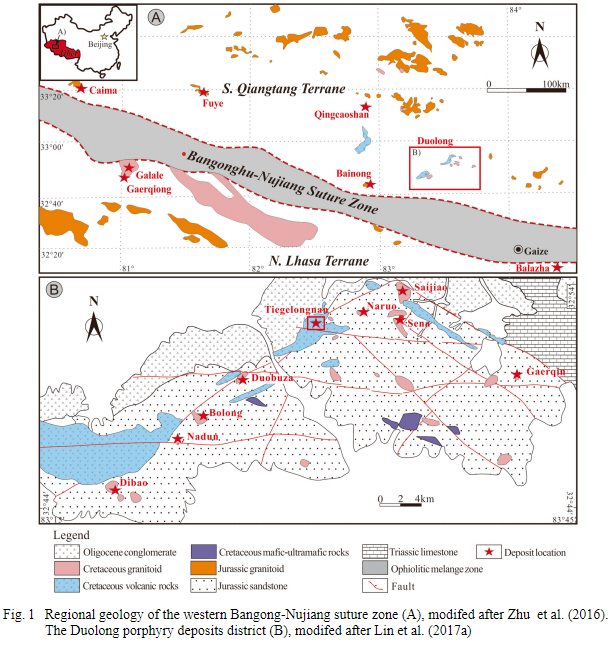
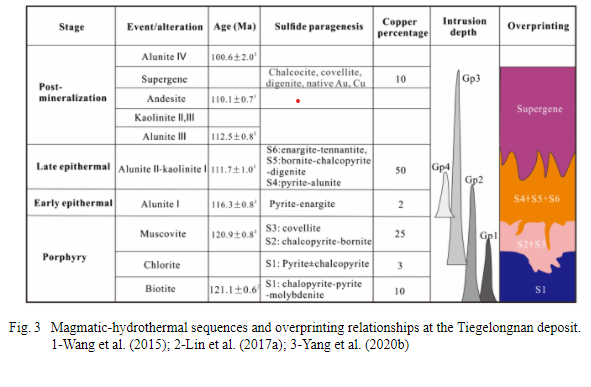
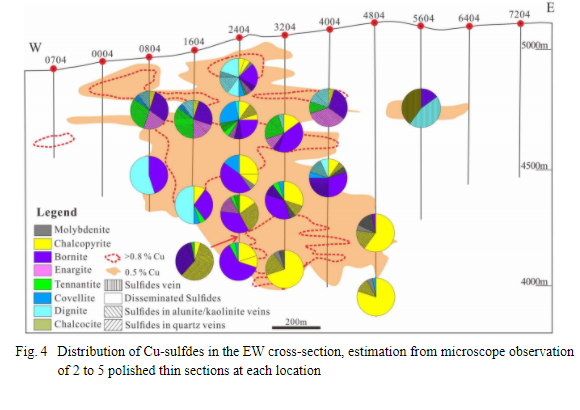
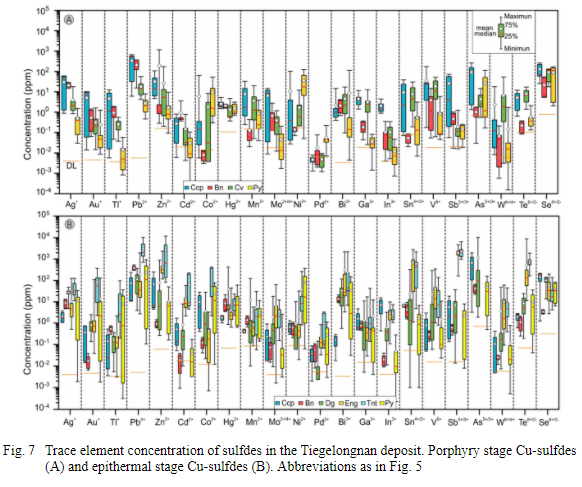
摘要:The Tiegelongnan porphyry-epithermal deposit (2089 Mt @ 0.53% Cu, 0.08 g/t Au) is host to a large variety of Cu-sulfde minerals, mainly chalcopyrite, bornite, covellite, digenite, enargite, and tennantite. We used LA-ICP-MS to investigate the trace element geochemistry of the Tiegelongnan Cu-sulfdes, as well as pyrite, to understand the correlation between sulfdes and trace elements, gold in particular, in the porphyry and epithermal systems. Porphyry mineralization consists of stage 1 chalcopyrite-pyrite ± molybdenite, stage 2 chalcopyrite-bornite, and stage 3 covellite. Epithermal sulfdes form stage 4 pyrite-alunite, stage 5 digenite-bornite-chalcopyrite, and stage 6 enargite-tennantite ± tetrahedrite. Stage 2 chalcopyrite (S2 Ccp, median = 9.7 ppm Au) is the primary porphyry Au host, and stage 6 tennantite in alunite veins (S6 Tnt-s, median = 98.0 ppm Au) is the major epithermal Au host. These Au-rich sulfdes formed under higher oxidation conditions, suggesting that a high oxidation state favors the incorporation of Au in Cu-sulfdes. Gold contents in coeval chalcopyrite and bornite are positively correlated to temperature, and Au is enriched in chalcopyrite over bornite at low temperatures (< 350 ℃). Positive correlations between Au and As and Te in covellite and chalcopyrite result from the reaction of As3+ + (Au+/Ag+) + Te2− ↔ 4Cu+ + S2−. Epithermal chalcopyrite and bornite contain more As and Pd than that in porphyry stages, and high contents of As, Sn, Cd, Zn, Sb, Te, Au, and Bi in epithermal enargite and tennantite are likely the result of partitioning of these elements in sulfdes at low epithermal temperatures. Epithermal overprinting likely leached Cu from earlier porphyry stage sulfdes to precipitate high Cu-grade epithermal mineralization. The Cu-sulfdes and related trace elements show a spatial distribution, potentially useful for the exploration of overprinted porphyry-epithermal systems.
文章链接地址:https://link.springer.com/article/10.1007/s00126-021-01075-y





 校内登录
校内登录