编号:CDUT-2020-62
标题:Fluid composition and evolution of the Langxi Ba-F deposit, Yangtze Block,
China: New insight from LA-ICP-MS study of individual fluid inclusion
入藏号:WOS:000571217000001
中国科学院文献情报中心期刊分区(升级版):地球科学2区/TOP
本校作者:邹灏*;李敏;Leon Bagas;李阳;蒋修未;陈海锋
来源出版物:Ore Geology Reviews 卷:125 文献号:103702
出版年:2020年
第一地址:成都理工大学油气藏地质及开发工程国家重点实验室
关键词:流体组成与演化;流体包裹体研究;郎溪Ba-F矿床;单个流体包裹体LA-ICP-MS分析
代表图:
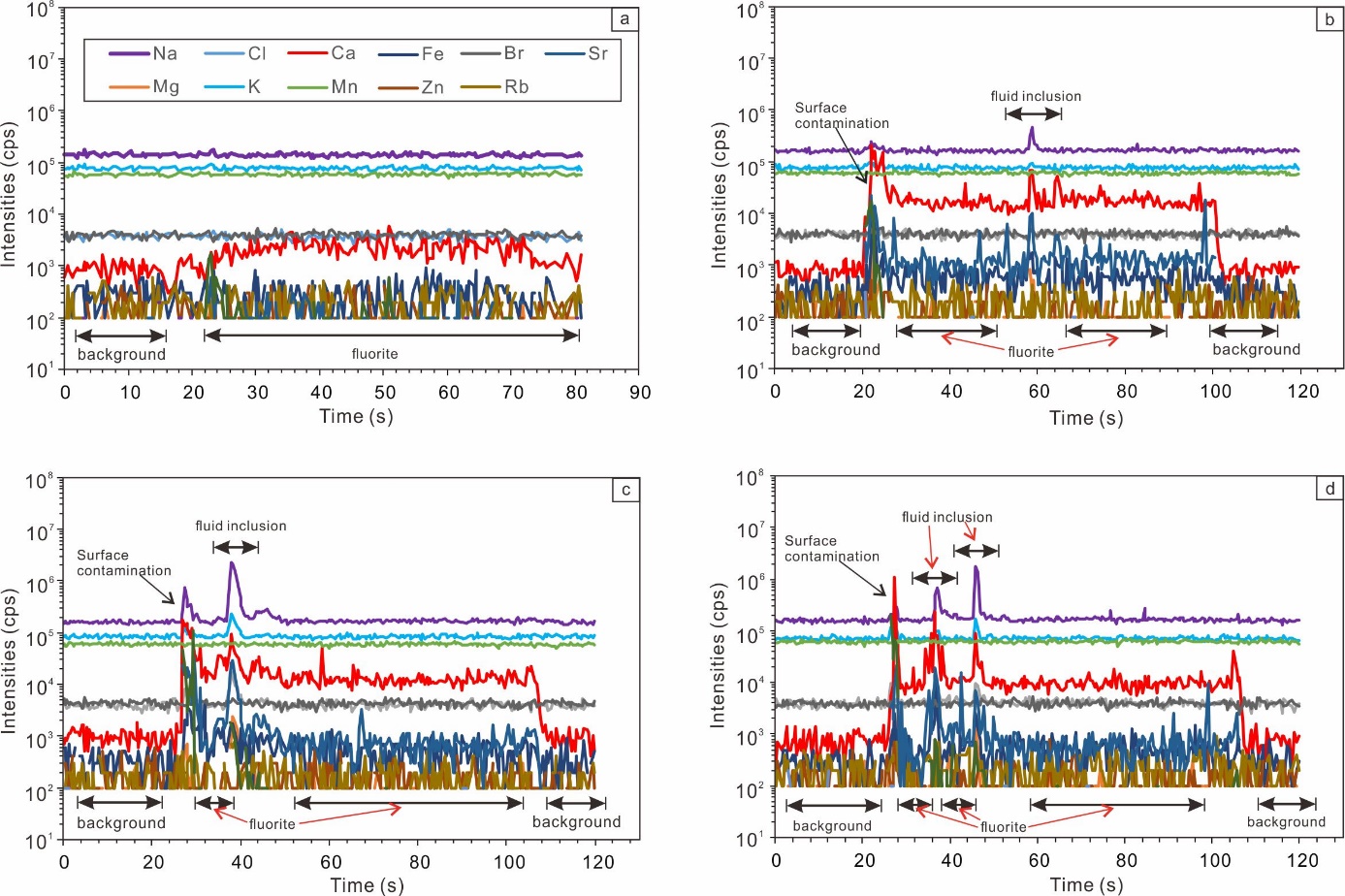
典型的时间分辨激光烧蚀信号:(a) 从萤石烧蚀中获得的精选元素,不含流体包裹体; (b) 和 (c) 以萤石为主体的 L-V 型流体包裹体; (d) 萤石中的两个 L-V 型流体包裹体。
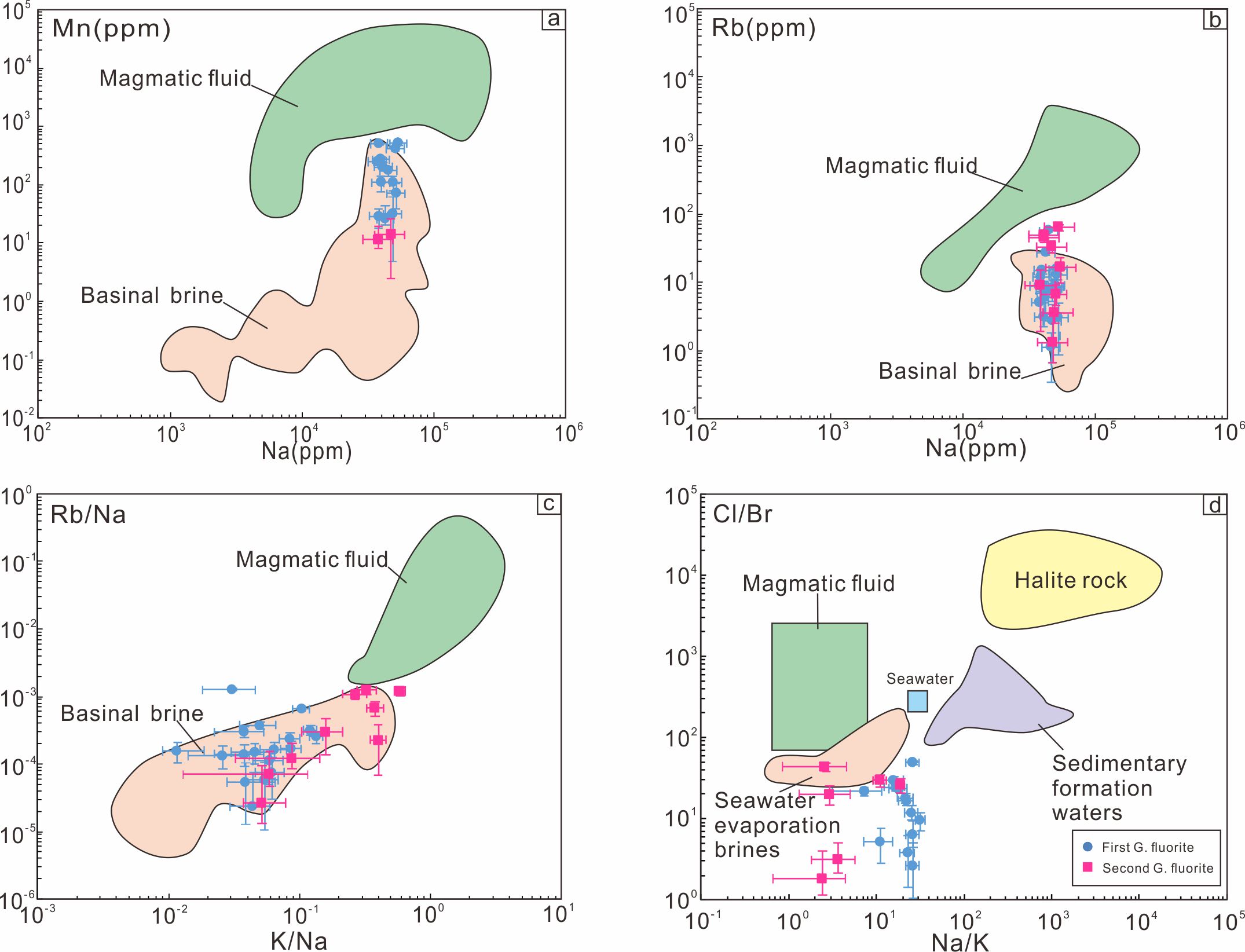
用于区分流体源的元素比率图。(a)、(b) 和 (c) 中的岩浆流体和盆地盐水域来自Shu et al. (2017), Samson et al. (2008), Williams-Jones et al. (2010), (d)中的岩浆流体域和其他流体端元数据来自Li et al. (2015)
摘要:The Langxi vein-type Ba-F deposit, located in the southeast of the Sichuan Basin in the central part of Yangtze Block, South China, is hosted by Ordovician limestone. The paragenesis of the deposit’s veins is subdivided into pre-, syn- and post-ore stages. The syn-ore stage includes two fluorite generations with the first (Fl-1) deposited at ~140° to 200° C and the second (Fl-2) at ~140° to 180 °C. The syn-ore barite mineralisation was deposited with the temperature range of 110°–160 °C, and the syn-ore calcite records a temperature range of 90° to 140 °C. These temperature ranges show that the mineralising fluids were low- to moderate in temperature and decreased with the initial deposition of fluorite followed by barite and then calcite. The types of fluid inclusions in the veins are classified as monophase liquid (L-type, type I), biphase liquid + vapour (L + V type, type II) and polyphase (L + V + S type, type III) brine inclusions. The salinity of the mineralising fluid for the three types of inclusions during the deposition of F-Ba-Ca is 0.35–21.7% NaCl eqv., indicating that the ore-forming fluid varied greatly during the mineralising process. There are no obvious differences in the fluid inclusion density in the different minerals with the average densities being 0.98 g/cm3 for Fl-1, 0.99 g/cm3 for Fl-2, 1.00 g/cm3 for barite, and 1.01 g/cm3 for calcite. This shows that the density of the F–Ba–Ca mineralising fluid belong to a moderate- low density. The deposition of the minerals took place with a change from a reducing to an oxidising environment. The liquid phase initially included Na+ and Cl−, and evolved containing Ca2+, SO42−, K+, and Mg2+. LA-ICPMS analyses reveal that the L-V type fluid inclusions associated with Fl-1 assays 46,600 ppm Na, 3470 ppm K (with a mean Na/K ratio of ~24), ~28,200 ppm for Cl, and 1060 ppm Br (with a mean Cl/Br mass ratio of ~27). The second-generation fluorite L-V type fluid inclusions average around 47,000 ppm Na and 12,000 ppm K, corresponding to and a Na/K mass ratio of 7. The halogen content of Fl-2 averages 26,200 ppm Cl and 950 ppm Br, corresponding to a Cl/Br mass ratio of 28. These analyses indicate that the mineralising fluid was rich in NaCl, assuming the fluid inclusions represent samples of the mineralising fluid. It is proposed that Ba-F concentrated in the mineralising fluid were derived from basinal fluids mixed with meteoric water circulating through faults at increased temperature gradients. The driving force was Late Cretaceous tectonic activity related to the subduction of the Paleo-Pacific Oceanic Plate. This model is consistent with the geodynamic setting of other barite-fluorite-rich districts in the Yangtze Block of South China.
文章链接地址:https://www.sciencedirect.com/science/article/pii/S0169136820302663?via%3Dihub





 校内登录
校内登录